
Beginners often struggle with keyboard learning because of simple but avoidable mistakes like poor hand position, skipping basics, inconsistent practice, and focusing only on songs instead of technique. Fixing these early helps you learn faster, play smoothly, and build strong musical skills.
Contents
- 1 Why Avoiding Beginner Keyboard Mistakes Matters
- 2 10 Common Keyboard Mistakes Beginners Should Avoid
- 2.1 1. Incorrect Hand Position on Keyboard
- 2.2 2. Ignoring Finger Numbering Techniques
- 2.3 3. Skipping Basic Music Theory
- 2.4 4. Practicing Without a Routine
- 2.5 5. Playing Too Fast Too Soon
- 2.6 Common Keyboard Mistakes Beginners Make While Practicing Daily
- 2.7 6. Not Using Both Hands Properly
- 2.8 7. Memorizing Songs Without Understanding
- 2.9 8. Poor Posture While Playing Keyboard
- 2.10 9. Avoiding Practice with Rhythm
- 2.11 10. Giving Up Too Early
- 3 Smart Tips to Improve Faster on Keyboard
- 4 Final Thoughts
Why Avoiding Beginner Keyboard Mistakes Matters
Learning keyboard is exciting, but many beginners slow down their progress without realizing it. Small errors in the beginning can turn into long-term habits that are hard to fix later.
When you avoid common keyboard mistakes beginners make, you:
- Learn faster with less frustration
- Build strong finger control and coordination
- Play songs smoothly and confidently
- Understand music better, not just memorize it
This guide breaks down the most common mistakes and shows you how to fix them in a simple way.
10 Common Keyboard Mistakes Beginners Should Avoid
1. Incorrect Hand Position on Keyboard
One of the biggest keyboard mistakes beginners make is placing hands incorrectly.
Many learners:
- Keep fingers flat
- Raise wrists too high or too low
- Use random fingers instead of proper fingering
Why it’s a problem:
Bad hand position reduces speed and control. It also causes strain over time.
How to fix it:
- Keep fingers slightly curved
- Relax your wrist (not stiff)
- Use all five fingers naturally
2. Ignoring Finger Numbering Techniques
Each finger has a number (1 to 5), but beginners often ignore this system.
Why it’s a problem:
Without proper fingering, you will struggle with speed and accuracy.
Fix:
- Follow finger numbers in lessons
- Practice scales slowly with correct fingers
- Don’t change fingering randomly
3. Skipping Basic Music Theory
Many beginners jump straight into songs without understanding basics.
Why it’s a problem:
You may play songs, but you won’t understand what you are playing.
Fix:
Learn simple concepts like:
- Notes (A to G)
- Scales
- Chords
This builds long-term skill.
4. Practicing Without a Routine
Inconsistent practice is a common keyboard mistake beginners face.
Why it’s a problem:
Irregular practice slows learning and reduces memory.
Fix:
- Practice daily (15–30 minutes)
- Keep a fixed time
- Focus on one goal per session
5. Playing Too Fast Too Soon
Beginners often try to play songs at full speed immediately.
Why it’s a problem:
This leads to mistakes and poor accuracy.
Fix:
- Start slow
- Increase speed gradually
- Use a metronome if possible
Common Keyboard Mistakes Beginners Make While Practicing Daily
Many keyboard mistakes beginners make happen during daily practice without noticing. For example, repeating exercises without focus, practicing errors again and again, or not correcting mistakes immediately. This creates wrong muscle memory, which becomes difficult to fix later. Another common issue is practicing without a clear goal. Beginners often play randomly instead of following a structured plan. To avoid this, always practice with intention and focus on one skill at a time, like finger control, chords, or rhythm. If you want proper step-by-step guidance, explore our online keyboard classes for beginners at Peppy Notes to build a strong foundation from day one.
6. Not Using Both Hands Properly
Many beginners rely heavily on the right hand.
Why it’s a problem:
Keyboard playing requires coordination between both hands.
Fix:
- Practice left-hand exercises separately
- Combine hands slowly
- Be patient with coordination
7. Memorizing Songs Without Understanding
Some learners copy notes without knowing patterns.
Why it’s a problem:
You forget songs quickly and cannot play new ones easily.
Fix:
- Understand chord patterns
- Learn why notes are used
- Break songs into sections
8. Poor Posture While Playing Keyboard
Sitting incorrectly affects your performance.
Common issues:
- Slouching
- Sitting too far or too close
- Keyboard height mismatch
Fix:
- Sit straight
- Keep elbows slightly above keys
- Maintain a relaxed position
9. Avoiding Practice with Rhythm
Rhythm is often ignored by beginners.
Why it’s a problem:
Even correct notes sound bad without timing.
Fix:
- Count beats while playing
- Use simple rhythm exercises
- Practice with backing tracks
10. Giving Up Too Early
Many beginners quit when learning feels slow.
Why it’s a problem:
Keyboard takes time. Progress is gradual.
Fix:
- Set small goals
- Celebrate small wins
- Stay consistent
Smart Tips to Improve Faster on Keyboard
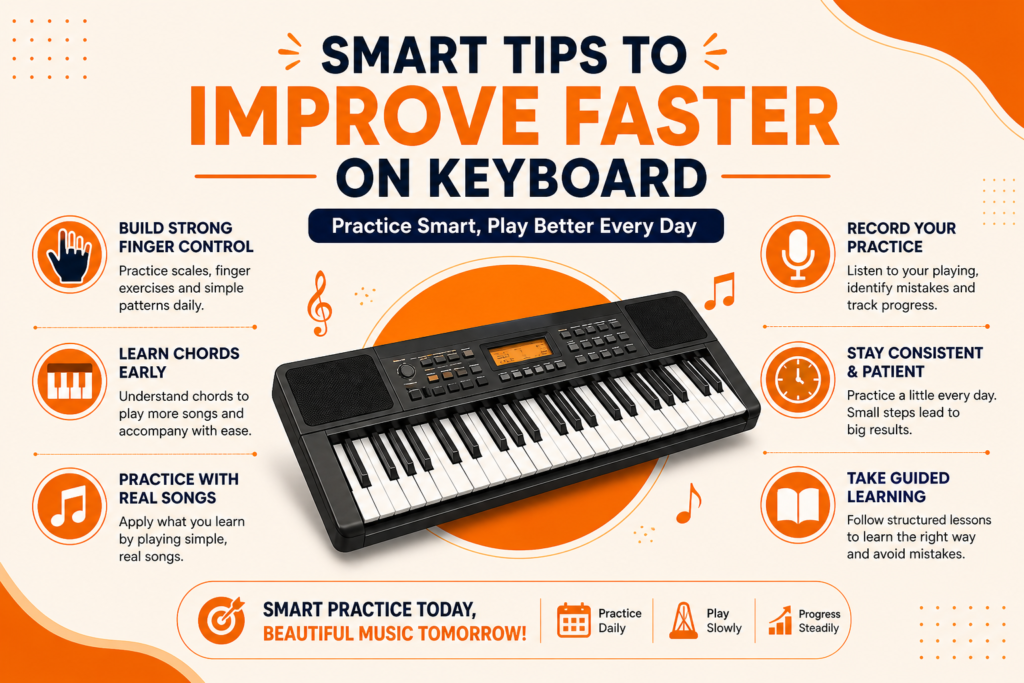
Build Strong Finger Control
Focus on exercises like:
- Scales
- Finger drills
- Simple patterns
This improves speed and accuracy.
Learn Chords Early
Chords help you:
- Play songs faster
- Understand music structure
- Accompany singing
Start with basic major and minor chords.
Practice with Real Songs
Once basics are clear:
- Choose simple songs
- Apply chords and melody
- Practice slowly
Record Your Practice
Listening to your playing helps you:
- Identify mistakes
- Track progress
- Improve faster
Take Guided Learning
Structured lessons help avoid confusion and common keyboard mistakes beginners make.
How to Fix Keyboard Mistakes Beginners Struggle With
Fixing keyboard mistakes beginners face is simple when you follow the right approach. Start by slowing down your practice and focusing on accuracy instead of speed. Break complex songs into small parts and master each section step by step. Use tools like a metronome to improve timing and rhythm. Learning from expert resources can also give you better clarity—beginner-friendly guides like this from Yamaha Corporation (https://hub.yamaha.com/pianos/p-how-to/eight-great-tips-for-practicing-piano/) explain effective practice techniques in a simple way. The key is consistency—small improvements every day lead to big progress over time.
Final Thoughts
Every beginner makes mistakes. That is a natural part of learning any new skill, including keyboard. In fact, mistakes help you understand what needs improvement. But the real problem starts when the same mistakes are repeated again and again without correction. Over time, these habits become part of your playing style and slow down your progress.
If you focus on a few important areas, your improvement will become much faster and more consistent:
- Correct technique:
Paying attention to hand position, finger movement, and posture from the beginning helps you play smoothly and avoid strain. Good technique builds long-term control and confidence. - Regular practice:
Practicing daily, even for a short time, is more effective than long but irregular sessions. Consistency helps your brain and fingers work together naturally. - Understanding music:
Instead of just memorizing notes, try to understand chords, patterns, and structure. This makes it easier to learn new songs and play without confusion.
When you combine these three elements, you start noticing steady progress. Your playing becomes cleaner, your timing improves, and you feel more confident at the keyboard.
Avoiding these keyboard mistakes beginners often make will give you a strong foundation. It will also make your learning journey smoother, more enjoyable, and far less frustrating. Over time, you won’t just play songs you will truly understand and enjoy music.
FAQs: Keyboard Mistakes Beginners
1. What are the most common keyboard mistakes beginners make?
Beginners often struggle with poor hand position, inconsistent practice, skipping basics, and playing too fast. Fixing these early helps build strong skills.
2. Why do beginners find keyboard learning difficult?
Most beginners lack a clear structure and repeat mistakes without guidance. A step-by-step approach makes learning much easier.
3. How can I avoid common keyboard mistakes as a beginner?
Focus on correct technique, practice regularly, and understand basic music theory. Small improvements each day make a big difference.
4. Is it okay to learn keyboard without learning music theory?
You can start without theory, but basic knowledge of notes and chords helps you progress faster and avoid confusion later.
5. How long should I practice keyboard daily as a beginner?
Practicing 15–30 minutes daily is enough. Consistency matters more than long practice sessions.
6. Why is hand position important in keyboard playing?
Proper hand position improves speed, accuracy, and comfort while playing. It also prevents strain and bad habits.
7. What is the best way to improve finger speed on keyboard?
Practice scales, finger exercises, and play slowly with accuracy. Speed improves naturally over time.
8. Why do I keep making the same mistakes on keyboard?
This happens when mistakes are repeated during practice. Slow down and correct errors immediately to avoid building bad habits.
9. Should beginners focus on songs or exercises first?
A balanced approach works best. Learn simple songs while practicing basic exercises and techniques.
10. How can I improve coordination between both hands?
Practice each hand separately first, then combine them slowly. Patience is key for coordination.
11. Is learning keyboard online effective for beginners?
Yes, online learning can be effective if lessons are structured and easy to follow, like the approach used at Peppy Notes.
12. Why is rhythm important in keyboard playing?
Without proper timing, even correct notes sound off. Practicing rhythm helps you play smoothly and musically.
13. Can I learn keyboard at home without a teacher?
Yes, but having proper guidance or structured lessons can help avoid common keyboard mistakes beginners often face.
14. What is the biggest mistake beginners make while practicing?
Practicing without focus or repeating mistakes is the biggest issue. Always practice with a clear goal.
15. How do I stay motivated while learning keyboard?
Set small goals, track progress, and play simple songs you enjoy. This keeps learning fun and engaging.
16. Should I use a metronome as a beginner?
Yes, a metronome helps improve timing and keeps your playing consistent.
17. How long does it take to learn keyboard basics?
With regular practice, most beginners can learn basic skills in a few weeks to a few months.
18. What type of keyboard is best for beginners?
A basic keyboard with touch sensitivity and enough keys is good to start. Focus more on learning than equipment.
19. How can structured learning help avoid mistakes?
Structured lessons guide you step by step, reducing confusion and helping you build skills correctly, similar to how platforms like Peppy Notes design beginner learning paths.
20. What is the easiest way to learn keyboard the right way?
Start with basics, practice consistently, and follow a clear learning plan. Guided platforms like Peppy Notes can make the process simpler and more organized.